Treats, No Tricks
FREE 10-Year Warranty
on any new standby generator
A $1,035 Value
or call 980-785-1118
Valid until October 31, 2026

Last updated September 2026 by the licensed electricians at JCT Electric Inc in Denver, NC.
Quick answer: Installing a Tesla charger at home means running a dedicated 240 volt circuit from your electrical panel to the charger location, mounting and hardwiring the Tesla Wall Connector, setting its breaker size during commissioning, and passing a permit inspection. A full speed 48 amp setup needs a 60 amp breaker. Installation typically costs about $600 to $1,500 when your panel has room and the charger goes in a garage near the panel, and more when it does not.
Tesla owners around Lake Norman ask us the same handful of questions: what is involved, what it costs, whether a regular electrician can do it, and whether they need a Tesla certified installer. This guide answers all of them in plain language so you know what a good installation looks like before anyone shows up with a drill.
Five things decide how simple your installation will be.
Tesla owners have three realistic ways to charge at home. Charging speed is set by the circuit behind the charger, so the choice is really a choice of circuit.
| Setup | Breaker size | Approximate range added per hour | How it connects |
|---|---|---|---|
| Tesla Wall Connector at full output (48 amps) | 60 amp | Up to about 44 miles | Hardwired |
| Tesla Wall Connector at reduced output (32 amps) | 40 amp | About 25 to 30 miles | Hardwired |
| Tesla Mobile Connector with a NEMA 14 50 adapter | 50 amp | About 25 to 30 miles | Plugs into a 240 volt outlet |
| Mobile Connector on a standard household outlet | 15 or 20 amp | About 3 miles | Plugs into a 120 volt outlet |
Actual range per hour depends on the vehicle, battery temperature, and state of charge.
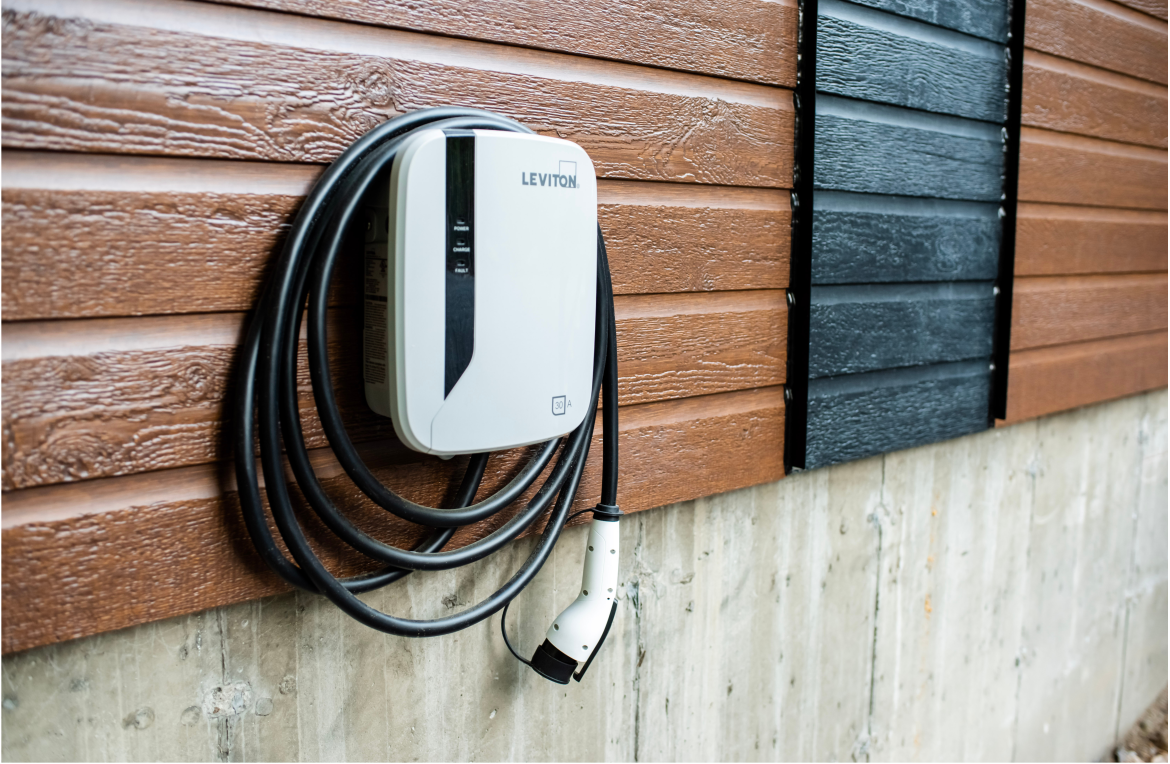
Our general recommendation is the hardwired Wall Connector. Here is why. Code requires ground fault protection on the outlet for a plug in EV charger, and a 50 amp GFCI breaker is an expensive part that can nuisance trip under a long charging session. Inexpensive 50 amp outlets also wear out and overheat when a car pulls near their limit for hours every night. A hardwired Wall Connector avoids both problems. The Universal Wall Connector also charges non Tesla EVs, which matters if your next car is a different brand.
A straightforward garage installation is usually finished in half a day. Longer runs, exterior installations, and panel work take longer.
These are typical installation ranges for homes in the Lake Norman area. They do not include the charger itself, which you buy from Tesla.
| Situation | Typical installation cost |
|---|---|
| Garage charger close to a panel with room | $600 to $1,200 |
| Longer run through an attic, crawlspace, or finished walls | $1,200 to $2,000 |
| Exterior wall, driveway post, or detached garage | $1,500 to $3,000 or more |
| Adding a load management device instead of upgrading service | Adds roughly $800 to $1,500 |
| Panel or service upgrade needed first | Adds roughly $2,500 to $5,000 or more |
Your price depends on distance, how the wire gets there, and what your panel can carry. We break those factors down in what it costs to install an EV charger at home in North Carolina.
Tesla maintains a directory of certified installers. These are electrical contractors who have been trained on Tesla charging equipment and agreed to Tesla’s standards, and the directory is a reasonable place to start a search.
What actually protects your home, your inspection, and your warranty is simpler: a licensed electrical contractor who pulls the permit and installs the charger according to Tesla’s installation manual and local code. Ask any installer to confirm in writing that the installation follows the manual. You can verify a North Carolina contractor’s license through the NC State Board of Examiners of Electrical Contractors.
Whoever you call, these questions separate a careful installer from a fast one.
North Carolina allows homeowners to pull a permit for electrical work on the home they live in, so it is legal in many cases. Whether it is wise is a different question. A 60 amp circuit carrying a heavy load for eight hours a night is unforgiving of a loose lug or undersized wire, and those mistakes show up as heat inside a wall long after the job looks finished. Most homeowners who are comfortable replacing a light fixture still hire this one out.
A typical garage installation near the panel takes about half a day. Long runs, exterior installations, and jobs that need panel work can take a full day or more, plus the time for the permit and inspection.
A 60 amp breaker for the full 48 amp output. The Wall Connector also works on smaller circuits, such as 40 or 50 amps, at a lower charging current that is set during commissioning.
Yes. The Wall Connector is rated for indoor and outdoor installation, which works well for homes without a garage or with a charger on a driveway wall.
The Universal Wall Connector charges both Tesla and other EVs. Other Wall Connector models can charge a non Tesla EV with the correct adapter.
Not always. Many homes can add a charger with no upgrade, and others can avoid one with a lower charger setting or a load management device. We explain how to tell in do I need a panel upgrade for an EV charger.
JCT Electric is a licensed electrical contractor based on N NC 16 Business Highway in Denver, serving homeowners across Lincoln, Catawba, Iredell, Gaston, and Mecklenburg Counties, including Mooresville, Cornelius, Huntersville, Davidson, Lincolnton, and Sherrills Ford. Our own licensed electricians handle the load calculation, permit, installation, commissioning, and inspection, and you get a firm written price before we start.
See our EV charger installation service, or call 980-785-1118 Monday through Friday from 8:30am to 4:00pm. Saturdays are available by appointment.