Treats, No Tricks
FREE 10-Year Warranty
on any new standby generator
A $1,035 Value
or call 980-785-1118
Valid until October 31, 2026

Charging on a standard wall outlet adds about four miles of range an hour. A Level 2 charger adds thirty or more. We size the circuit, confirm your panel can carry it, run the wiring, and handle the permit so you wake up to a full battery.
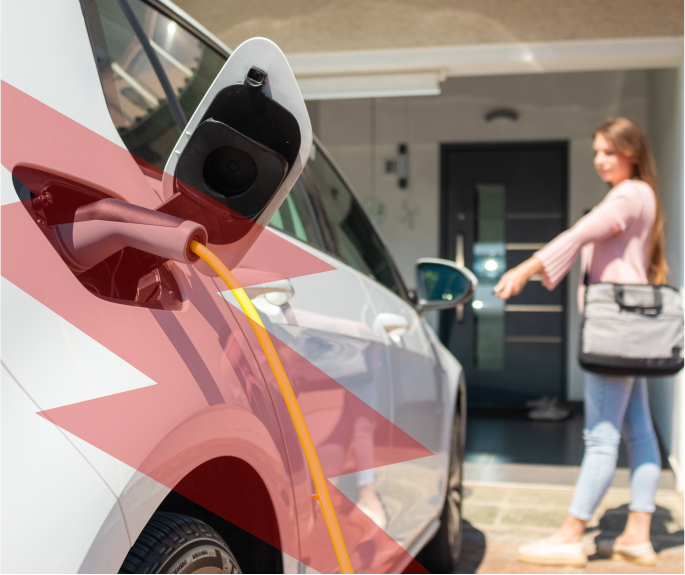
A Level 2 charger is a large, continuous load. It pulls its maximum current for hours at a time, which is very different from anything else in your house. That is why it needs its own properly sized circuit and why the panel matters so much.
Every install comes down to four things:
We check all four before we quote, so nothing turns into a surprise halfway through the job.
An EV charger runs at full load for hours, night after night. Undersized wire and a loose connection will not fail on day one. They fail in year two, usually as heat.



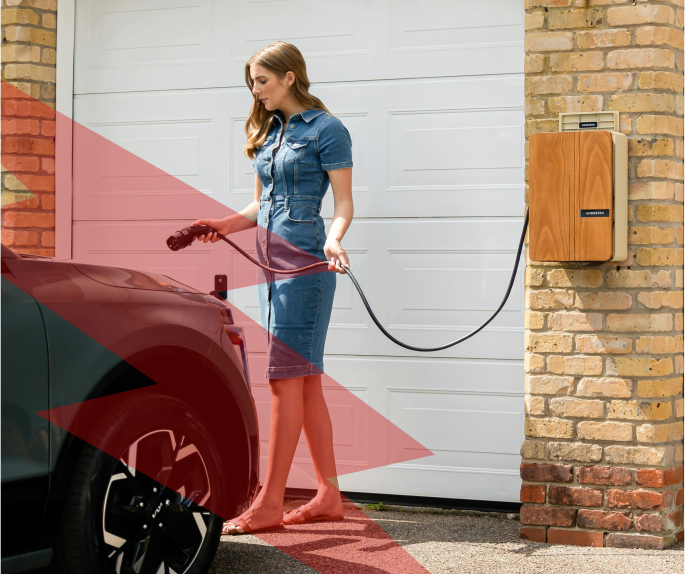
Whatever you drive and whichever charger you chose, we install it to manufacturer spec and to code.
The whole job usually happens in one visit once we know what your panel can carry.
EV adoption around Lake Norman has climbed fast, and every county permits these a little differently. Our shop is on N NC 16 Business Highway in Denver, and we install chargers throughout Lincoln, Catawba, Iredell, Gaston, and Mecklenburg Counties.

What Denver area EV owners ask us most before installing a home charger.
The single biggest variable is distance from your panel to where the charger goes. A charger mounted on the wall directly behind the panel is inexpensive. A run across the house to a detached garage costs more. If your panel is full or your service is undersized, that gets quoted separately so you can see exactly what is driving the price.
Not always. Plenty of homes with 200 amp service have room for a charger without any changes. Older 100 amp services often do not. If capacity is tight, a load management device can let the charger share capacity with your dryer or range instead of paying for a full service upgrade. We tell you which situation you are in before quoting.
Hardwired is the better long term install. It allows the full 48 amp charging rate on units that support it, removes the receptacle as a failure point, and is required outdoors in some situations. A NEMA 14 50 receptacle is a good choice if you want to take the charger with you when you move.
A 40 amp charger delivers roughly thirty miles of range per hour, and a 48 amp unit somewhat more. For nearly every driver that means plugging in overnight and leaving with a full battery, regardless of what you drove the day before.
Yes. A new 240 volt dedicated circuit is permitted work in Lincoln, Catawba, Iredell, Gaston, and Mecklenburg Counties. We pull the permit and meet the inspector. Keep the paperwork, because rebate and tax credit programs often ask for it.
Yes. That usually means running an underground feeder to the building and, in many cases, setting a small subpanel so the garage has its own breakers. It is more involved than a garage attached to the house, but it is very common work for us.
Charging on a standard outlet works until the day you actually need range. A Level 2 circuit fixes that permanently.

Charger speed is set by the circuit behind it, not by the box on the wall. A 48 amp charger needs a 60 amp circuit and heavier wire, because continuous loads are sized at 125 percent. Install that same charger on a 40 amp circuit and it simply charges slower, which is a fine outcome as long as you knew going in.
Capacity is the other half. Every home has a fixed service size, and an EV charger is often the largest single load anyone has ever added to it. If your calculated load leaves room, the install is straightforward. If it does not, you have two paths.
The first is a service or panel upgrade, which makes sense if you were near your limit anyway or plan to add a heat pump, hot tub, or second vehicle. The second is a load management device, which lets the charger monitor total household draw and back off automatically when other large appliances run. That is often thousands of dollars cheaper, and we will tell you honestly which one your house actually needs.