
Federal Pacific and Zinsco Panels: What Lake Norman Homeowners Need to Know
Most homeowners never think about the grey metal box on the garage wall until something goes wrong. But if that box carries a Federal Pacific, Zinsco, or Challenger label, it is worth a few minutes of your attention, because these particular panels have a documented history of not doing the one job they exist to do.
We replace a lot of them around Denver, Lincolnton, and the older neighborhoods of the Lake Norman area. Here is what they are, how to identify yours, and what your options actually are.
Why These Panels Are Different
A circuit breaker has one critical safety function. When a circuit draws more current than the wire can safely carry, the breaker must trip and cut the power before that wire overheats.
With most panels, that happens reliably for decades. With Federal Pacific Stab Lok and Zinsco panels, independent testing and a long record of field failures found that a meaningful percentage of breakers did not trip when they should have. The breaker looks fine, the handle is in the on position, and the circuit behind it is quietly running past its safe limit.
That is a different kind of problem from a worn out panel. A tired panel gives you symptoms. These can fail silently.
Federal Pacific Stab Lok
Federal Pacific Electric was one of the largest panel manufacturers in the United States from roughly the 1950s into the early 1980s, so these are extremely common in homes of that era. The product line most homeowners encounter is branded Stab Lok.
The concerns that emerged over time centered on breakers that failed to trip under overload conditions at rates far higher than the industry norm, and on breakers that could appear seated while not making proper contact with the bus bar. The company was also found to have misrepresented testing certifications, which is part of why the topic still carries weight decades later.
How to identify one: look for the words Federal Pacific, Federal Pacific Electric, FPE, or Stab Lok on the panel door, the label inside, or the breakers themselves. Stab Lok breakers commonly have a distinctive thin red or orange stripe across the toggle.
Zinsco and Sylvania Zinsco
Zinsco panels, sometimes labeled Sylvania Zinsco after the company changed hands, were installed widely from the 1950s through the 1970s. The failure mode here is somewhat different.
Zinsco breakers connect to an aluminum bus bar, and over time that connection can corrode and overheat. The result is a breaker that can literally melt to the bus, at which point it can no longer trip regardless of what the circuit is doing. Inspectors frequently find scorching and melted plastic inside these panels.
How to identify one: look for Zinsco, Sylvania Zinsco, or GTE Sylvania on the label. The breakers often have colorful toggles, blue, red, green, or yellow, which stands out against the more uniform look of modern panels.
Two More Worth Knowing About
Challenger panels from the late 1970s and 1980s have raised similar concerns about overheating at the breaker connection, and many inspectors treat them the same way.
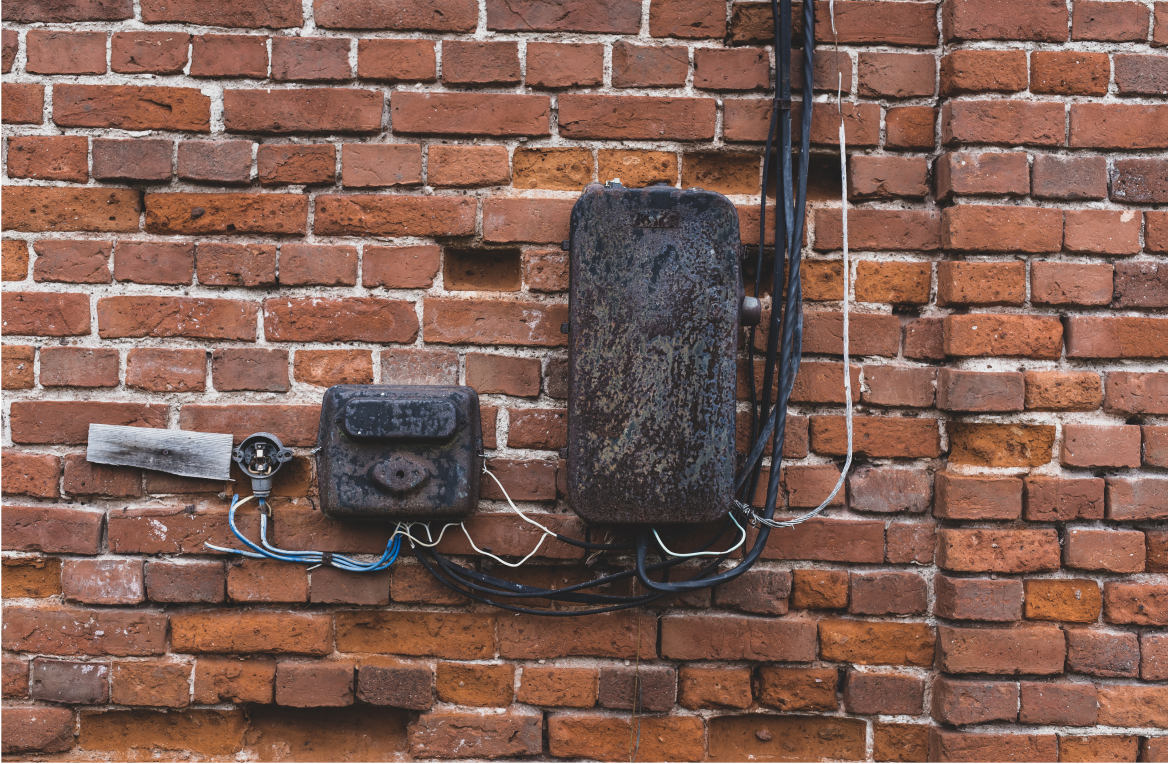
Fuse boxes. If your home still has screw in fuses rather than breakers, you are looking at a system that predates modern expectations entirely. Fuses themselves are not inherently unsafe, but a fuse box in service today is almost always undersized for a modern household, has no ground, and invites the dangerous habit of replacing a blown 15 amp fuse with a 30 amp one to stop the nuisance.
Why Your Insurance Company Cares
This is how most people find out they have one. Carriers have tightened up considerably, and it is now common to see a Federal Pacific or Zinsco panel trigger one of the following.
- A refusal to write a new policy on the home
- Non renewal of an existing policy
- A requirement to replace the panel within a set window, often 30 to 60 days
- A significantly higher premium
The same thing happens in real estate transactions. A buyer inspection flags the panel, the lender or the buyer requires it addressed, and suddenly there is a correction standing between you and a closing date. We do a fair amount of this work on a deadline for exactly that reason.
Can They Just Be Repaired?
Not meaningfully, and this is the question we get most.
Replacing individual breakers inside a Federal Pacific or Zinsco panel does not solve the problem, because the issue is with the breaker design and the bus connection rather than one worn part. Replacement breakers for these panels are also increasingly hard to source, and the aftermarket options vary in quality.
The accepted fix is replacing the panel itself with a modern one, which also gives you the opportunity to correct grounding and bonding, add space for future circuits, and bring the service up to what the house actually needs today.
What a Panel Replacement Involves
A service panel replacement is a permitted job in every county we work in, and it involves your utility, because power has to be disconnected and reconnected at the meter. Here is the shape of it.
- A load calculation to size the new service correctly, which is often where homes move from 100 amp to 200 amp
- Permit pulled through Lincoln, Catawba, Iredell, Gaston, or Mecklenburg County depending on your address
- Coordination with Duke Energy or EnergyUnited for the disconnect and reconnect
- New panel, new breakers, and every circuit clearly labeled
- Grounding and bonding brought up to current code, which older installations frequently lack
- Final inspection, which gives you documentation for your insurer or your closing
Most residential replacements are completed in a single day. Your power will be off for part of that day while the service is swapped, usually several hours, and we schedule the utility work in advance to keep that window as short as possible.
You can read more about what is included on our electrical panel upgrades page.
What It Costs
Most residential panel replacements land in the low to mid four figures. The variables that move the number are the service size, the condition of the meter base and service entrance conductors, whether the panel has to be relocated, and how much correction the existing grounding needs.
We quote it after a free in home assessment, itemized, so you can see what is driving the price rather than getting a single number with no explanation. You approve it before any work starts.
What to Do Next
If you are not sure what you have, take a photo of the panel label and the breakers and send it over, or call and describe what you see. In a lot of cases we can tell you over the phone whether it is something to act on or leave alone.
If you already have an insurance letter or an inspection correction notice, bring it to us. We price those line by line and meet the inspector for the reinspection so your policy or your closing keeps moving.
A dated panel is not something that has to be handled this week. But it is also not something to keep putting off for another five years, particularly if the wiring behind it is the same age. If you are already dealing with older wiring, our page on rewiring and code corrections covers what usually comes up.
Serving Denver and the Lake Norman Area
Our shop is on N NC 16 Business Highway in Denver, and we replace panels throughout Lincoln, Catawba, Iredell, Gaston, and Mecklenburg Counties. Every job is done by our own licensed electricians. No subcontractors, ever.
Call 980-785-1118 or request a free quote and we will take a look at what you have.