
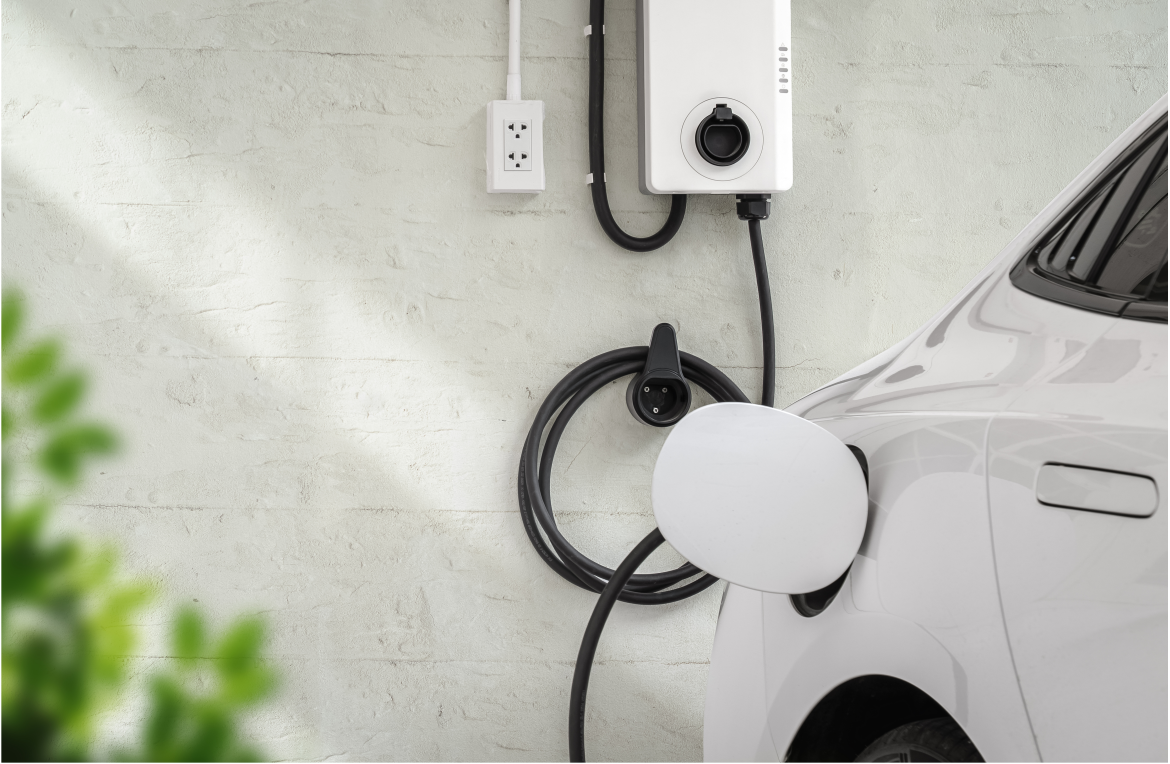
What It Costs to Install an EV Charger at Home in North Carolina
If you have just bought an electric vehicle, or you are about to, the charging question comes up fast. The cable that came with the car works, technically, but plugging into a standard wall outlet adds only about four miles of range an hour. Overnight that is maybe 40 miles. For most drivers that is fine right up until the day it is not.
A Level 2 charger changes that to roughly 30 miles of range per hour, which means you wake up full every morning regardless of what you drove the day before. Here is what that actually costs to install in North Carolina and, more usefully, what makes the number move.
The Short Answer
For a typical home where the panel has capacity and the charger goes on a garage wall reasonably close to the panel, installation generally lands in the high hundreds to low thousands of dollars, not counting the charger unit itself.
That range is wide on purpose, because two houses on the same street can differ by a factor of three. What follows is what decides where you land.
What Actually Drives the Price
1. Distance From the Panel
This is the single biggest variable. A charger mounted on the wall directly behind the panel needs a few feet of wire. A charger on the far side of a detached garage might need a hundred feet of heavy cable, a trench, and a subpanel.
The wire for a Level 2 circuit is not cheap either. A 48 amp charger requires a 60 amp circuit, and the conductor size that goes with that costs real money per foot.
2. Whether Your Panel Has Capacity
This is the one people do not anticipate, and it is where a straightforward job can turn into a bigger one.
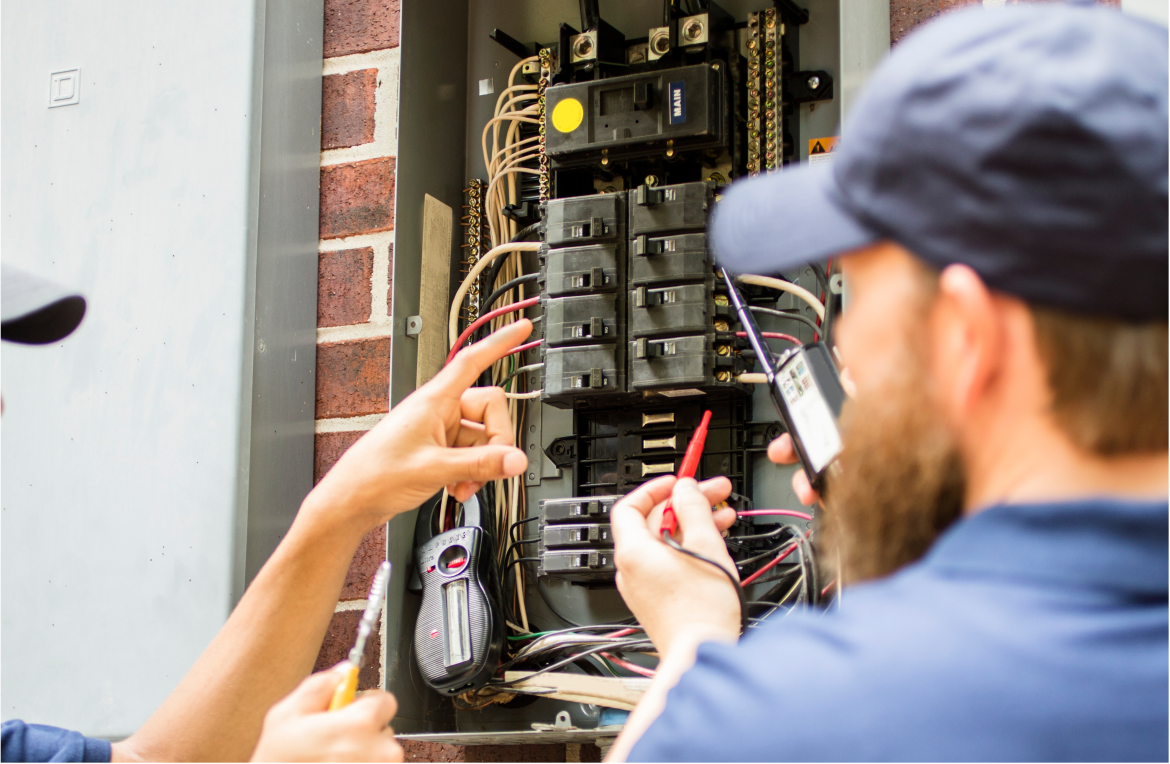
An EV charger is the largest continuous load most homes will ever add. It pulls its maximum current for hours at a stretch, which is very different from a dryer or an oven that cycles. Your service has a fixed capacity, and an electrician has to calculate your existing load before adding something that size.
Homes with 200 amp service usually have room. Homes still on 100 amp service, which is common in the older neighborhoods around Denver, Lincolnton, and Stanley, often do not. If your panel is also full with no open breaker spaces, that is a second constraint on top of capacity.
3. The Wall and the Route
An unfinished garage with exposed studs is quick. Finished walls, brick, block, or a route that has to cross the house through conditioned space all add labor and sometimes drywall repair.
4. Permit and Inspection
A new 240 volt dedicated circuit is permitted work in Lincoln, Catawba, Iredell, Gaston, and Mecklenburg Counties. The permit fee itself is modest, and any reputable installer includes pulling it and meeting the inspector in the quote. Keep that paperwork, because rebate and tax credit programs often ask for proof of a permitted installation.
Hardwired or a NEMA 14 50 Outlet?
You have two ways to connect a Level 2 charger and the choice affects both cost and performance.
A NEMA 14 50 receptacle is the same style of outlet used for an electric range. You plug the charger into it. This is a good choice if you want to take the charger with you when you move, and it is sometimes slightly cheaper. The tradeoff is that it caps you at 40 amps of charging, and the receptacle itself becomes a wear point. Cheap receptacles in this application have a track record of overheating, so this is not a place to save twenty dollars on the part.
Hardwiring connects the charger directly to the circuit with no plug. It allows the full 48 amp charging rate on units that support it, removes the receptacle as a failure point, and is generally the better long term installation. It is also required in some outdoor situations.
For most homeowners who plan to stay put, we recommend hardwired.
If Your Panel Is Full, You Have Options
This is worth understanding before anyone quotes you a service upgrade, because there are two paths and they differ by thousands of dollars.
A service or panel upgrade makes sense if you were already near your limit, if your panel is old or recalled, or if you are planning to add other large loads like a heat pump, a hot tub, or a second vehicle. You are solving the capacity problem permanently. Our panel upgrades page covers what that involves.
A load management device is the alternative a lot of installers never mention. These monitor total household demand and automatically reduce or pause charging when other big appliances are running. Since your car sits in the garage for eight or ten hours overnight, briefly backing off while the dryer runs costs you almost nothing in practical terms. This can let a 100 amp service support a charger without a full upgrade, and it is often thousands of dollars cheaper.
An honest electrician will run the load calculation and tell you which situation you are actually in. If someone quotes a service upgrade without ever calculating your load, get a second opinion.
How Fast Will It Actually Charge?
Charging speed is set by the circuit behind the charger, not by the box on the wall. A 40 amp charger delivers roughly 30 miles of range per hour. A 48 amp unit delivers somewhat more. Both require a circuit rated 25 percent higher than the charger draw, because continuous loads are sized that way by code.
Practically speaking, either one refills a normal day of driving several times over while you sleep. Paying for the fastest possible charger makes sense mostly for very long commutes, two vehicle households sharing one charger, or vehicles with unusually large batteries.
Detached Garages and Outbuildings
If the charger is going in a detached garage, the job usually involves running an underground feeder to the building and, in many cases, setting a small subpanel there so the building has its own breakers. It is more involved than an attached garage, but it is common work and it often improves the building generally, since most detached garages around here are running off one undersized circuit.
Questions Worth Asking Any Installer
- Did you perform a load calculation, and can I see it?
- Are you pulling a permit, and is the inspection included in the price?
- Is the price firm, or is it an estimate that can change?
- If my panel is short on capacity, will you show me the load management option as well as an upgrade?
- Who is actually doing the work, your employees or a subcontractor?
That last one matters more than people expect. We do every job with our own licensed electricians, which means the person who quotes your install works for the same company that stands behind it.
Serving Denver and the Lake Norman Area
EV adoption around Lake Norman has climbed quickly, and each county handles these permits a little differently. Our shop is on N NC 16 Business Highway in Denver, and we install chargers throughout Lincoln, Catawba, Iredell, Gaston, and Mecklenburg Counties.
We start with a free load and panel check so you know before you commit whether this is a simple install or something bigger. See our EV charger installation page for details, call 980-785-1118, or request a free quote.